Archive for the ‘Blog’ Category
The Hidden Challenges of PPE and Active Fall Protection
91% of surveyed safety managers report they sometimes or often have issues with employees wearing appropriate PPE (personal protective equipment)
In an effort to better understand the challenges facing safety managers across the country, the JJ Keller Center conducted a survey of 172 such professionals, asking them about their biggest PPE-related obstacles.
The most commonly cited PPE challenge was not cost, functionality, or availability – instead, it was getting employees to wear their PPE in the first place.
Eighty-three percent of respondents said they often have issues with employees wearing their PPE, with another 8% saying they sometimes do. The most common reason why, according to these safety professionals, was that their employees “just didn’t want to wear it” (72% of respondents) with another 52% saying they have had workers say they “didn’t think it was necessary.”
This is a difficult challenge to overcome, as it requires buy-in from your staff – and close managerial oversight to ensure its execution. When it comes to an active fall-protection system, this means monitoring employees to guarantee they use their harnesses, lifelines, and anchor points.
But what if this PPE challenge – employee usage – could be entirely eliminated? With a guardrail-based rooftop safety system, it can.
The beauty of guardrails is their simplicity: they require no active participation on behalf of the workers. Everybody performing maintenance on the roof is protected at all times – without needing to engage with the equipment at all. Why worry about whether or not your employees will wear their PPE at all (resulting in both potential injuries or fatalities as well as compliance concerns) when you can install safety rails and guarantee it?
Contact SRC today to see how we can build a passive fall-protection system for your facility, and bypass the challenges of worker PPE buy-in.
Sources here and here.
Harness Expiration: Active Fall Protection Complications
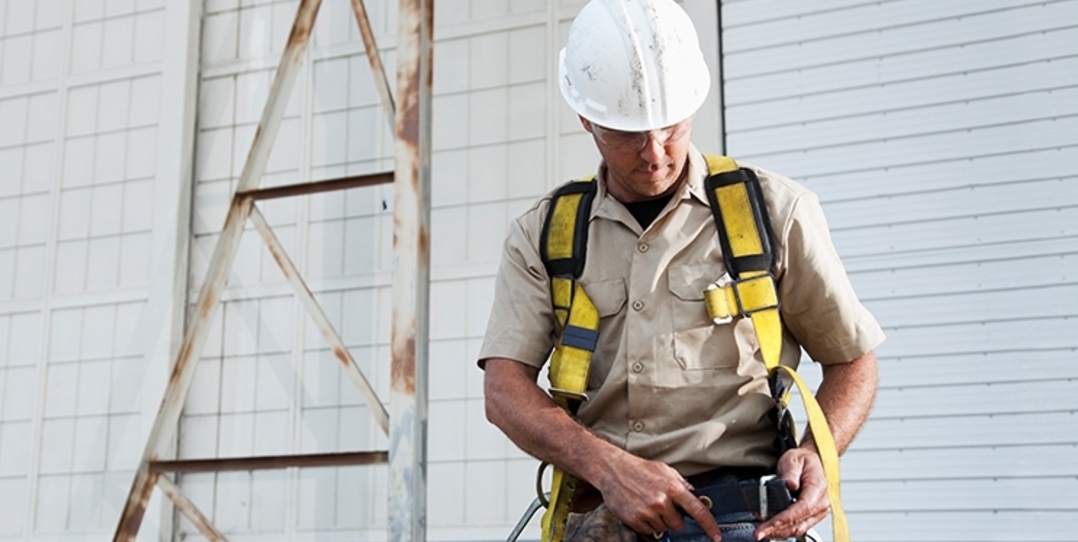
Do harnesses have an expiration date?
The expiration of a harness is determined by regular inspections and adherence to the manufacturer’s instructions, considering factors like usage, storage, and exposure conditions.
How do you know if your harness is still usable and safe?
Harness inspections should be performed before every use and at least every six months by a trained inspector, following detailed guidelines from OSHA.
Guardrails, in contrast, are simple to install and maintain, requiring no user training or ongoing maintenance, making them an ideal passive fall-protection system.
Avoid the complexities of harnesses by opting for a straightforward guardrail system that provides peace of mind and safety.
Learn more about the inspection guidelines and the advantages of guardrail systems here.
3 Worker Advantages of a Guardrail Safety Solution
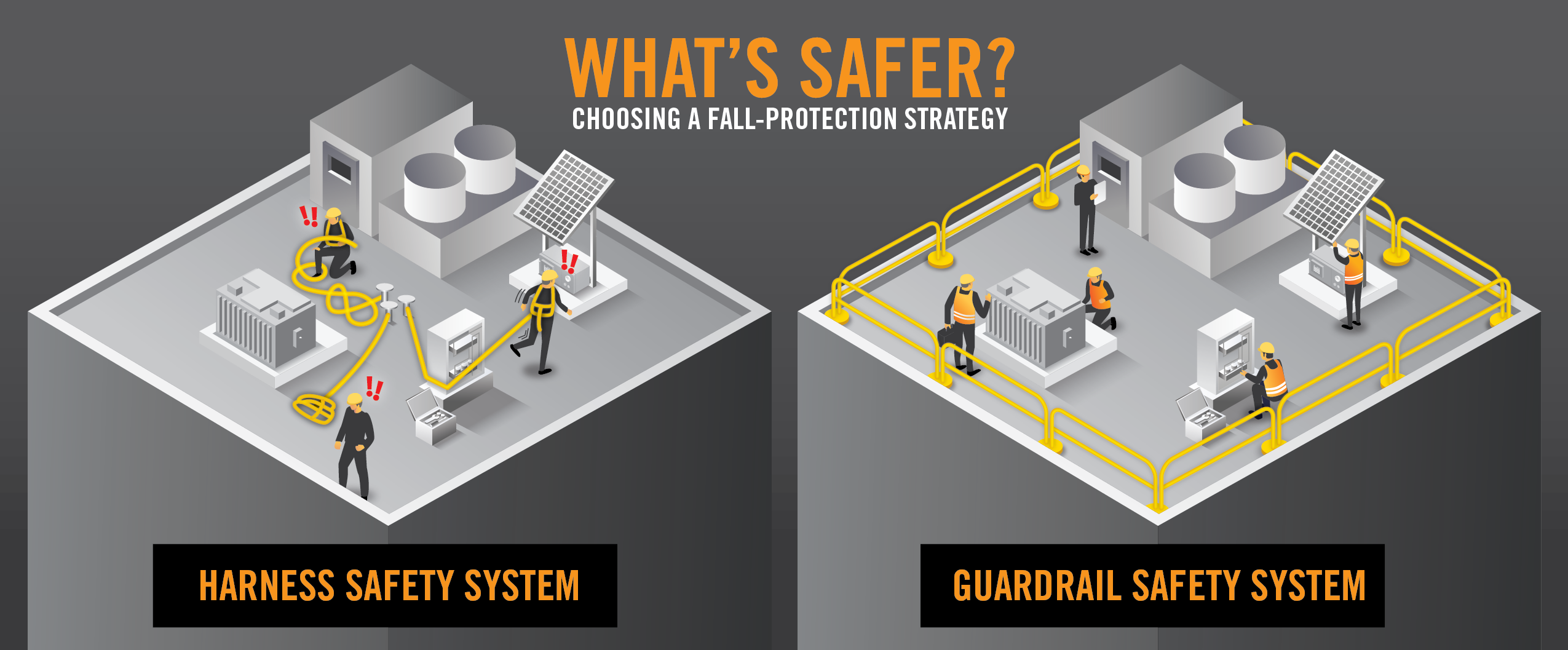
Harnesses or guardrails — which fall-protection strategy is safer and more productive?
While harnesses may seem simpler and cheaper, guardrails offer significant organizational and safety benefits, such as minimal inspections and maintenance, no rescue plan requirements, and lower ongoing costs. Guardrails also provide simplicity and safety for workers, allowing them to perform their duties without interaction with the system.
Guardrails Require No User Adoption
Guardrails need no adoption by personnel, ensuring safety and compliance without any action required by the employee.
Increased Efficiency and Productivity
Guardrails do not restrict workers’ mobility like harness lifelines do, which increases efficiency and productivity.
Guardrails Provide Universal Protection
Guardrails offer protection to everyone on the roof, unlike harness systems that have capacity limits.
Guardrails are a simpler, safer, and more effective long-term solution for rooftop safety. Fall protection is critical, and proactive measures can prevent violations and ensure a safe workplace.
Find out more about the benefits of guardrails and get help building a safety system from SRC here.
7 Things You May Not Know About OSHA Inspections
OSHA Conducts 35,000 Inspections per Year
Throughout the year, OSHA conducts approximately 35,000 federally mandated inspections. This number jumps to 60,000 in states with approved OSHA state plans. And, given the recent proposed increase to the OSHA budget that is likely to come into effect for the 2023 fiscal year, it’s reasonable to assume this number will continue to rise. Most of these inspections are done without notification.
Very Few OSHA Inspections Find 0 Violations
Most OSHA inspections are triggered by negligence, employee complaints, injuries, or industry focus. Nearly all inspections reveal at least one violation.
OSHA Inspections Can Take up to 6 Months to Complete
Inspections can be either partial or comprehensive, with the latter possibly taking up to six months.
OSHA Inspector Can Expand Inspection During Walk-Through
An inspection can be upgraded from partial to comprehensive if new violations are found during the walk-through.
OSHA Has 6 Months to Send Official Citation List
OSHA reviews all inspection data before sending an official list of violations and penalties within six months.
OSHA Penalties Have Increased 80% Since 2015
Penalties have increased significantly, with violations ranging from $14,000 to $145,000 depending on severity and business factors.
Employers Have Three Choices After Receiving Citation List
- Accept the penalties and correct the issues.
- Contest the outcome within 15 days.
- Request a conference with the OSHA Area Director.
Learn more about OSHA inspections here.
Increased OSHA Budget Proposed by Senate
OSHA Fall-Protection Budget
Fiscal year 2023 is likely to see an increase in federal funding for OSHA. The new budget will, in all probability, land somewhere between $679 and $712 million — at least a $68 million increase from 2022’s budget of $611 million.
This money will be used in a number of ways, including the hiring of as many as 500 new employees — 179 of which are likely to be inspectors.
This is good news, from a safety perspective: the increased budget and enforcement of OSHA compliance regulations will lead to safer work environments and fewer jobsite injuries. This also means, however, that companies need to remain vigilant about their safety planning. The added number of inspectors will of course lead to increased jobsite inspections; thus, companies need to be proactive as opposed to reactive.
Because improper fall-protection safety standards is OSHA’s number one violation for seven consecutive years, it’s reasonable to assume that this citation will be at the top of these new inspectors’ minds. Don’t wait for a fee from OSHA to institute a rooftop safety plan. Contact Safety Rail Company today to see how we can craft a site-specific solution for your facility — and help you avoid those non-compliance costs!
Passive Fall Protection
Also, do your research to learn why passive fall protection has far fewer OSHA-compliance concerns than its active fall-protection counterpart. Among the many benefits of a guardrail-based system is its simplicity: simply install it and leave it. With harness-based systems, the user must constantly be interacting with the equipment: from training and maintenance to inspections and replacement. This is to say nothing of the compliance concerns: with safety rails, you know you’re fully in compliance at all times. With harnesses, compliance depends upon the organization and the user properly using the equipment (which requires costly training and ongoing education).
Rooftop guardrails provide the most universal, safest solution for rooftop fall hazards.
Sources can be found here and here.
OSHA Compliance vs. Cal-OSHA Compliance
DID YOU KNOW THAT CALIFORNIA’S FALL-PROTECTION STANDARDS ARE MORE STRINGENT?
While reviewing your facility’s fall-protection options under federal OSHA compliance, California residents should also be asking themselves: is it Cal-OSHA compliant? The rules between the two regulatory organizations differ, with California demanding more of safety and facility managers with its stricter standards — especially when it comes to guardrail codes.
There are a number of distinctions between OSHA standards and Cal-OSHA standards pertaining to general industry, starting with the height of the top rail. Federal OSHA regulations require the top rail to be placed 42” above the walking surface, allowing a +/-3 vertical tolerance — this means the top rail can be placed anywhere between 39” and 45” above the walking surface (1910.29.b.1). Cal-OSHA, on the other hand, requires the top rail to be positioned at least 41” above the walking surface (3209.a).
The maximum length of a single railing also differs, with federal OSHA standards allowing 10-foot rail length between stanchions versus the 8-foot maximum rail lengths required by Cal-OSHA (3209.c).
Finally, the force requirements are far more stringent under Cal-OSHA regulations than those enforced by federal OSHA standards. Federal guidelines require a single railing length to withstand 200 pounds of pressure (1910.29.b.3). Cal-OSHA instead measures force based on linear foot, requiring 20 pounds of force to be withstood for every linear foot throughout the entire length of the rail system (3209.b).
|
FEDERAL OSHA |
CAL-OSHA |
| Top Rail Position |
39” to 45” above walking surface |
41” to 46” above walking surface |
| Maximum Single Rail Length |
10 feet |
8 feet |
| Force Requirements |
200 pound point load |
20 pounds per linear foot along entire rail system |
The bottom line is that California facility and safety managers need to remain vigilant — just because a fall-protection system is compliant with federal OSHA guidelines does not make it Cal-OSHA compliant. And the unfortunate truth is that there are a number of guardrail systems in the market that do not comply with the more rigid California standards.
At Safety Rail Company, we pride ourselves on integrity. Our entire purpose is to ensure your facility’s compliance with all applicable regulations, including those in California. We take the time to assess our clients’ needs and engineer a system just for them.
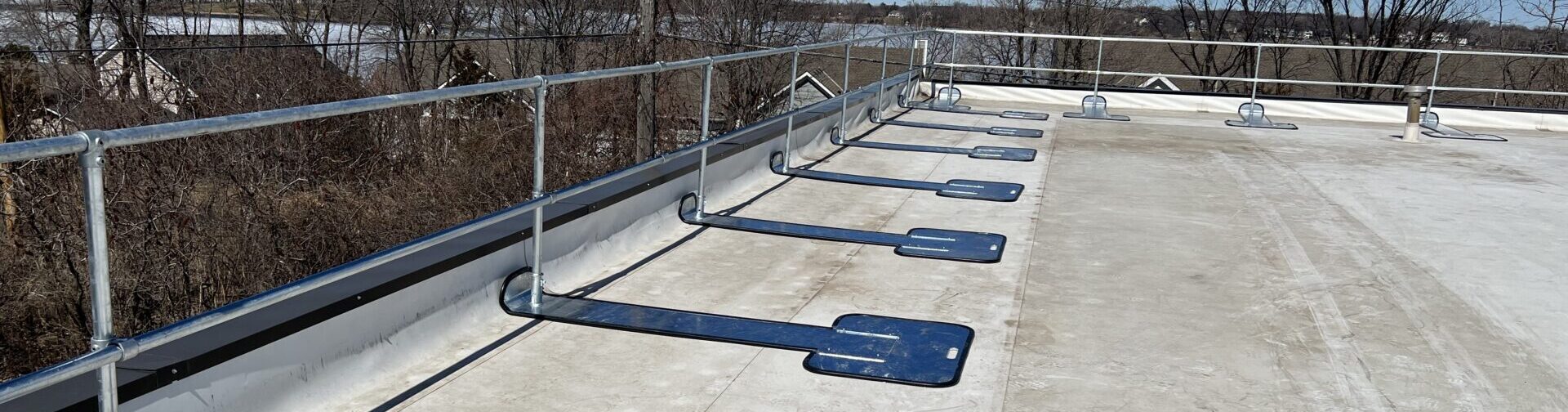
This is why we built the Accu-Fit Cal 3209: a guardrail system designed specifically for California compliance. With the Accu-Fit Cal 3209, there’s no need to worry whether your fall-protection system is compliant: we’ve done that for you, supported with third-party, independent-certified and sealed testing documentation. And, as with most of our fall-protection solutions, the Accu-Fit Cal 3209 is non-penetrating, utilizing low-profile bases that do not require drilling into the roof membrane.
- Federal OSHA Compliance Does Not Always Equal Cal-OSHA Compliance
- Stricter California Regulations Require Higher Top Rail, Shorter Rail Lengths, and Ability to Withstand Tougher Force Standards
- SRC’s Accu-Fit Cal 3209: Built for Heavy-Duty California Compliance and Independently Tested to Meet All Requirements
In the end, it’s important for California residents to remember that federal OSHA compliance is only one piece of the puzzle — Cal-OSHA has their own, more strict set of rules. Be sure to review your fall-protection plan to guarantee it adheres to all regional standards — and please feel free to contact Safety Rail Company for expert advice: we’ll gladly help you craft a site-specific Accu-Fit 3209 system for your California facility!
Rooftop Hatchguards
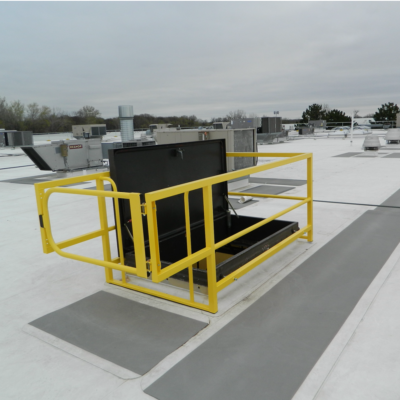
At Safety Rail Company, we do more than just protect your roof’s leading edge — we build entire systems to address every potential fall hazard at your facility. This includes open rooftop hatches, which OSHA defines as an equal hazard to a leading edge or unprotected hole (OSHA 1910.28(b)(3)). Enter SRC’s Rooftop Hatchguards.
Check out our latest product video that provides a quick, simple overview of what makes the Rooftop Hatchguard system the best, most durable solution on the market — which includes:
Simple Installation
SRC’s Rooftop Hatchguards are first and foremost easy to install. Each four-piece system bolts together and simply slips over the hatch. And installation requires no penetration into either the building or the hatch itself — its compression grip holds it securely in place.
Durable, Rigid Design
Our system is also among the sturdiest in the industry with very little wobble and endurance through any weather conditions. Built to last, it remains as rigid and durable years down the line as it did the day you installed it. Unfortunately, many of the hatch-protection systems in the market do not provide this stability — and selecting a system that wobbles or re-positions itself during usage is nearly as bad as having no hatch protection at all. Protect your employees with the safest system in the industry!
User-Friendly Features
Also, the SRC Rooftop Hatchguard’s user-friendly system includes grab bars (for employees entering and exiting the hatch) as well as a two-foot landing zone and a self-closing safety gate. Simply installing guardrail around the hatch does not provide these same worker-friendly features that make entering and exiting the hatch area easy and convenient.
OSHA Compliant
Because OSHA requires fall protection measures for open rooftop hatches, the SRC Rooftop Hatchguard is also the simplest way to ensure regulatory code compliance. Why wonder whether or not your fall-protection strategy adheres to this OSHA requirement when you can be certain with the SRC Hatchguard?
Protect against all rooftop fall hazards with SRC’s dynamic roster of fall-protection solutions!
Safety Rail Company Installation Services
Initiating a fall-protection project can feel like a daunting task — there’s a lot to consider, including who is going to complete the installation of your products.
First, you have to select a strategy: do you choose an active (harnesses) or passive (guardrails) system? This is often one of the most difficult decisions to make, and SRC provides an educational resource that we urge all safety managers to read here that spotlights the often overlooked benefits of passive fall protection. And, in the event you do select a passive fall-protection system, you then have to consider which products are right for your facility.
One final and often overlooked consideration, however, is what you’re going to do once you receive your selected product, particularly as regards permanent systems like guardrails. Receiving a pallet of rails without industry expertise in how to properly install them can be overwhelming (and potentially hazardous to employees tasked with putting them in place).
Luckily, Safety Rail Company has you covered! SRC removes the anxiety of fall-protection planning by being a single-source partner – we not only provide site-specific planning and our very own American-made products, but also professional installation services.
Our team of installation experts are SRC employees, never third-party subcontractors, who specialize in handling our fall-protection products. We employ best-in-class safety protocols with minimal impact to your facility – in fact, most of our products are free-standing, meaning they require no permanent building alterations or roof-membrane penetration.
Why stress yourself out with the installation process when you can trust the experts to do it for you? Safety Rail Company is a turn-key partner, ready and willing to engineer, build, and install your next rooftop safety project!
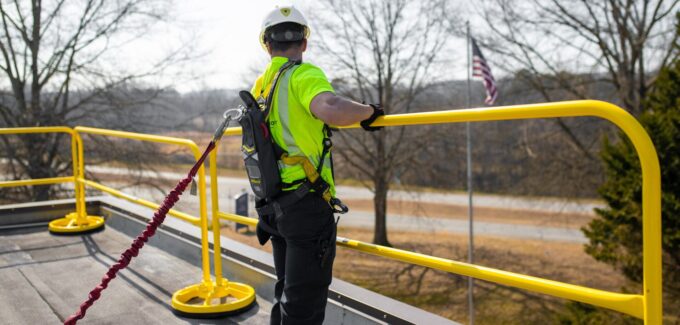
Fall Protection: OSHA’s Most-Cited Violation
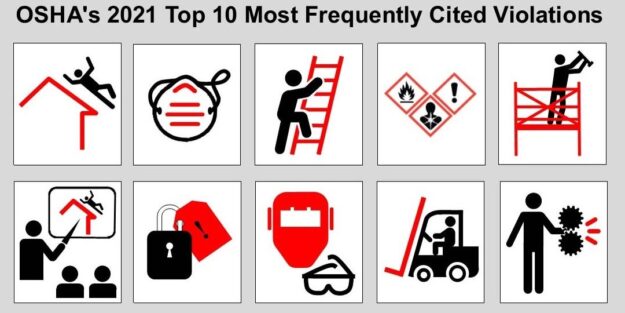
As it does every year, OSHA has released its 2021 top ten list of most-cited workplace violations — and, for the eleventh time in a row, failure to have appropriate fall protection (1926.501) ranks number one.
With 5,271 violations, fall protection more than doubled the second most common violation (respiratory protection), which had 2,521 citations. Likewise, lack of proper fall-protection training (1926.503) also made the top ten list with 1,670 violations. And, using the average OSHA fee for this particular citation (just over $5,400), the yearly national penalty for lack of fall protection totaled more than $28 million (to say nothing of the additional $2.7 million collected for lack of fall-protection training).
While obviously the primary purpose of fall protection is to keep personnel safe and productive while working at heights, it’s also important to remember that it’s more than just a moral and safety issue — it’s a legal obligation. And, as companies continue to lapse in their fall-protection safety measures, OSHA will in turn continue to prioritize this during their on-site inspections.
The best method for mitigating these OSHA violation fees is to be proactive — don’t wait until you’ve been fined to construct a fall-protection safety plan for your facility. Contact Safety Rail Company to see how we can help build you a site-specific, OSHA-compliant system!
Sources can be found here, here, and here.
Guardrail for Any Application
SRC’s Comprehensive Lineup of Guardrail Systems
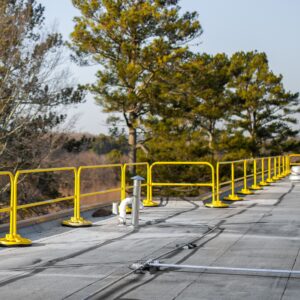
Safety Rail Company is known for its backbone product: the SRC360 Mobile Rail, the most versatile guardrail system in the fall-protection industry — an OSHA-compliant solution that secures into our weighted bases that do not penetrate the roof membrane and work in tandem with our other safety products, including gates, hatch guards, skylight protection, and more.
And certainly, the benefits of a passive fall-protection system (guardrails) are numerous: no training necessary, limited maintenance and inspections, universal protection for all workers, freedom of movement, minimal ongoing costs, etc.
But not all roofs are created equal — so, which system is right for your facility? SRC’s lineup of guardrail options is deep, with a perfect solution for just about every professional application. Our guardrail options are sure to provide a solution for any need, from aesthetic requirements to tricky roofs and rooftop obstacles.
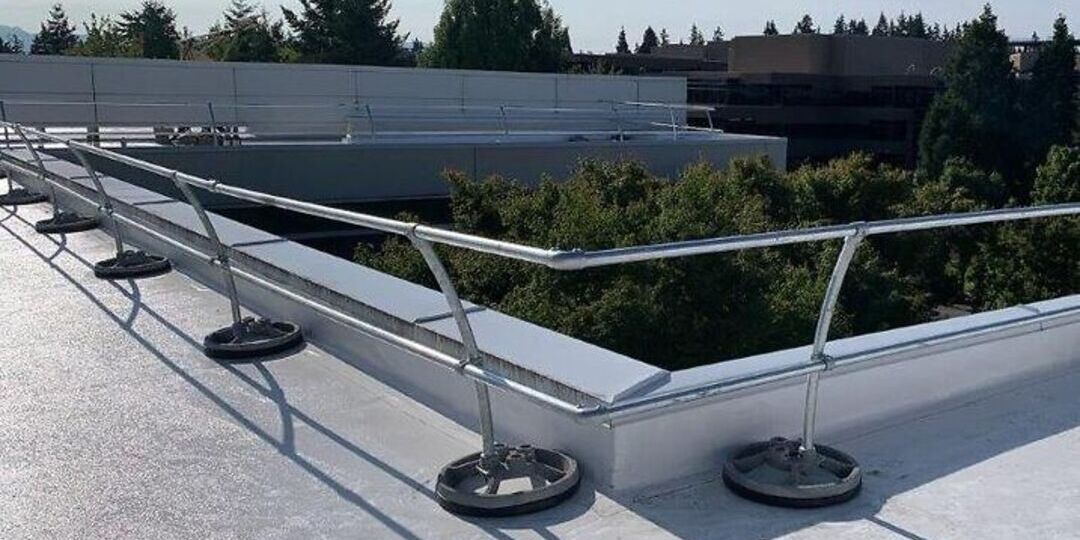
GUARDRAIL AESTHETICS
Sometimes a simple yellow safety rail just won’t do. Many facilities have a particular architecture they’re trying to complement or a general building aesthetic they’re trying not to interrupt.
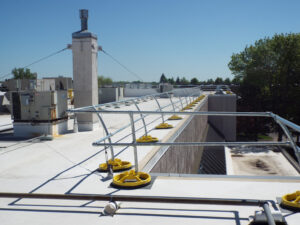
Safety Rail Company is equipped for such needs — our Accu-Fit rails are built with design in mind! This rail system features a choice of stanchions, including a curved option whose purpose is to work within the architectural sight lines of the building.
Likewise, our Hide-a-Rail system is perfect for tucking away the rails while not in use. This allows your facility to maintain its appearance while also providing total fall protection to your personnel when work is being done in the area.
And, while we prefer yellow rails, we realize this isn’t always the ideal choice: color personalization is available upon request!
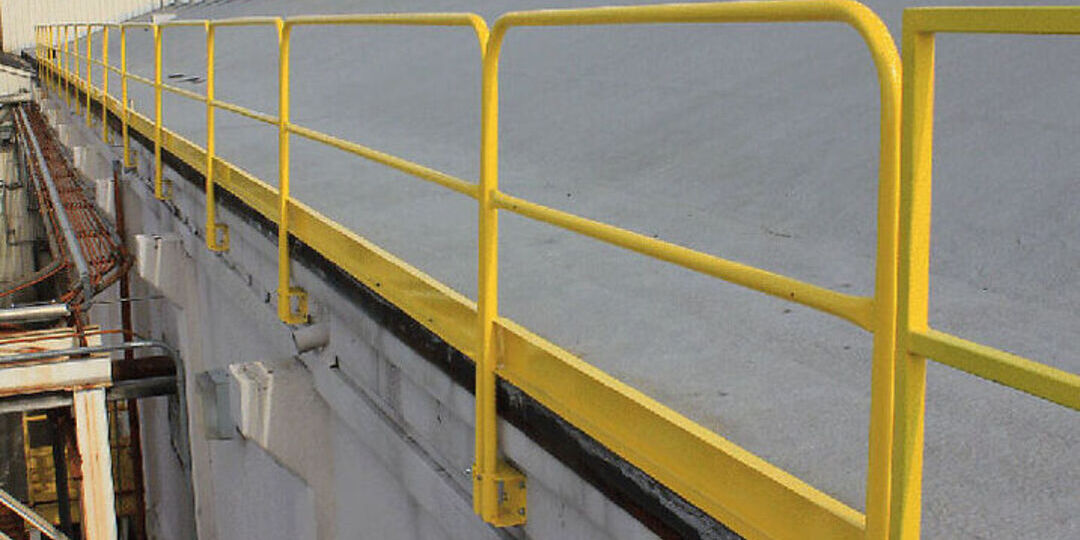
GUARDRAIL UTILITY
As any safety manager or fall-protection expert can testify, no two rooftops are the same. While we’d like to provide simple, non-penetrating guardrail to protect every facility’s leading edge, we know the truth is that sometimes the project is more complex.
But, much like our numerous design-conscious options, SRC has a solution for every knotty rooftop hazard.
Firstly, the Accu-Fit rails are good for more than just eye-catching sophistication: they’re also a rugged system meant to be cut to size in the field. This allows for a number of applications around tricky rooftop obstacles.
SRC also has a solution for those hard-to-protect metal deck roofs with our standing seam rails, which secure to just about any style rooftop.
Finally, Safety Rail Company also offers permanent rail for inclined roofs or indoor facility areas in need of protection (including around shipping pits, etc.).